
- TOP
- News Releases
- Effort toward Oxygen-Enriched Combustion Technology in the Aluminum Melting Process ーDemonstration of CO₂ Emissions Reduction by Up to 24.1% Compared to Conventional Air Combustionー
News Releases
Jan 21, 2026
- Products/Technology
Effort toward Oxygen-Enriched Combustion Technology in the Aluminum Melting Process ーDemonstration of CO₂ Emissions Reduction by Up to 24.1% Compared to Conventional Air Combustionー
January 21, 2026
Nippon Light Metal Co., Ltd.
Nikkei MC Aluminium Co., Ltd.
Taiyo Nippon Sanso Corporation
Effort toward Oxygen-Enriched Combustion Technology in the Aluminum Melting Process
ーDemonstration of CO2 Emissions Reduction by Up to 24.1% Compared to Conventional Air Combustionー
Three companies jointly demonstrated that applying oxygen-enriched combustion technology to the aluminum melting process reduces CO₂ emissions by up to 24.1% compared to conventional air combustion. These companies are Nippon Light Metal Co., Ltd. (Headquarters: Minato-ku, Tokyo; President: Ichiro Okamoto), Nikkei MC Aluminium Co., Ltd. (Headquarters: Minato-ku, Tokyo; President: Masashi Koyama), and Taiyo Nippon Sanso Corporation (Headquarters: Shinagawa-ku, Tokyo; President: Kenji Nagata; hereinafter “TNSC”), which is a Japanese industrial gas company in the Nippon Sanso Holdings Group.
1. Background of the demonstration test
To achieve carbon neutrality by 2050, reducing greenhouse gas (GHG) emissions from Japan’s approximately 37,000 industrial furnaces is an urgent priority. Against this backdrop, the three companies have focused on oxygen-enriched combustion technology*1, and have conducted a joint demonstration test in a melting furnace for secondary aluminum alloys.
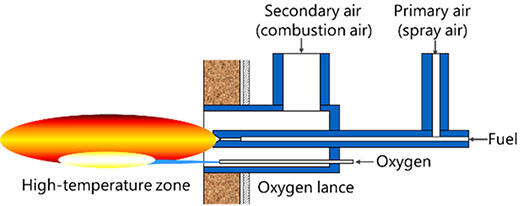
Figure 1 Oxygen lance system
*1 Oxygen-enriched combustion technology reduces heat loss from exhaust gases by enriching the air used for combustion with oxygen, thereby improving thermal efficiency and reducing CO2 emissions.
2. Overview and results of the demonstration test
We applied oxygen-enriched combustion technology using an oxygen lance system (Fig. 1) to Nikkei MC Aluminium’s commercial aluminum melting furnace and conducted melting tests with oxygen concentrations of up to approximately 40%. As a result, we confirmed a maximum reduction of 24.1% in CO2 emissions compared to conventional air combustion, demonstrating the benefits of energy savings and carbon offset. We have confirmed that there are no increases in environmental impacts such as NOx emissions—a trade-off associated with an oxygen-rich atmosphere—nor any effects on product quality, yield, operations, or equipment. Through this demonstration test, we confirmed the potential to achieve an even higher level of efficiency in aluminum melting by optimizing the oxygen-enriched concentration and the position of oxygen injection.
3. Role of each company in the demonstration test
| Company name | Role |
|---|---|
| TNSC | Planning the demonstration test, designing an oxygen-enriched combustion system, conducting computational fluid dynamics (CFD) analysis, and supplying oxygen. |
| Nippon Light Metal | Supporting demonstration test planning, supporting the modification of equipment around the melting furnace, and providing expertise on aluminum melting. |
| Nikkei MC Aluminium | Providing a demonstration test site, supporting demonstration test planning, and performing operation and product verification. |
Given the numerous achievements gained through this demonstration test, we will continue our efforts to reduce GHG emissions in aluminum manufacturing.
[Reference: Website of each company]
Nippon Light Metal Co., Ltd.: https://www.nikkeikin.co.jp/
Nikkei MC Aluminium Co., Ltd.: https://www.nmca.jp/
Taiyo Nippon Sanso Corporation: https://www.tn-sanso.co.jp/jp/
For PDF printing
Effort toward Oxygen-Enriched Combustion Technology in the Aluminum Melting Process ーDemonstration of CO₂ Emissions Reduction by Up to 24.1% Compared to Conventional Air Combustionー (PDF)